Pixi AI
An assistant that reads your handbook.
Pixi answers from your policies, documents, and records rather than the open internet. Retrieval is scoped to a single tenant, and every answer can show the source it came from.

This week
What's included
What Pixi does
Narrow, checkable tasks where a wrong answer is visible immediately — not autonomous decisions about people.
Grounded answers
Questions about leave, policy, or benefits answered from your knowledge base and policy library, with the source article cited.
Resume screening
Candidate summaries against the requisition's stated criteria, surfaced as a shortlist with reasoning a hiring manager can override.
Document drafting
First drafts of policies, letters, job descriptions, and review summaries, built from your templates and existing language.
Inclusive language check
Job posts and internal comms flagged for exclusionary or biased phrasing before they go out.
Daily brief
What needs attention today across approvals, expiring credentials, overdue compliance tasks, and open tickets.
Model routing
Each task is assigned a primary and fallback model. Change the assignment per task without touching application code.

The screens
Pixi AI in the product
Screens from the working product, filled with sample data so you can see the shape of the thing before you talk to us.
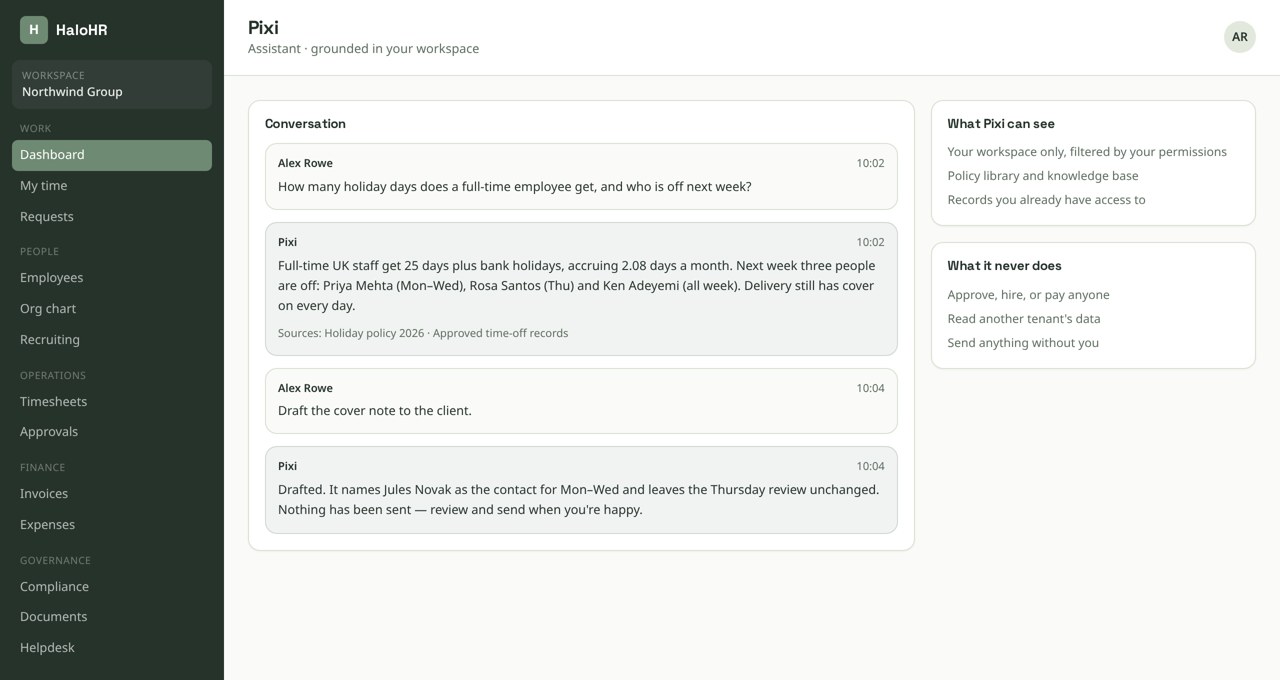
Screens shown with sample data from a demonstration workspace.
Pixi AI · Pixi AI
Ask in plain language. Act on what comes back.
Reminders, escalations, and status changes fire from the same rules, so nothing sits in a queue because a person forgot to look.
It drafts and suggests; it never approves, hires, or pays anyone on its own.
How it runs
How a question gets answered
The retrieval path is deliberately boring, because that is what makes it auditable.
The question is scoped to your tenant
Before retrieval runs, the query is bound to the asking user's tenant and permissions. Documents they cannot open are not candidates.
Relevant passages are retrieved
Your policies, knowledge base articles, and uploaded documents are embedded and searched. Only matching passages go to the model.
The model answers from those passages
The prompt instructs the model to answer from the supplied context and to say so plainly when the context does not cover the question.
Sources are shown with the answer
Each answer links back to the article or document it drew on, so the employee can read the original.
The call is logged
Model, prompt tokens, completion tokens, latency, and cost are recorded per invocation and visible in the platform usage dashboard.
From our founder
“We stopped chasing spreadsheets and started actually talking to people again.”
Sean Morrison — Founder, HaloHR

Built in
What we will not do with your data
Answer the buyer's first question before they ask it.
- Retrieval never crosses a tenant boundary — embeddings are stored and queried per tenant
- Your data is not used to train models; calls go to the provider under a no-training arrangement
- Provider API keys live server-side only and are never exposed to the browser
- Pixi drafts and suggests; it does not approve, hire, terminate, or pay anyone
- Per-tenant usage and spend are visible, with model assignments configurable per task
Keep exploring
Connected to the rest of the platform
Every module writes to the same database, so a change in one place shows up everywhere else.